Jul 6, 2026 ● APJ Staff Writer
Exploring a Career in Clinical Informatics: What Every APP Should Know
If you've ever left work frustrated by an electronic health record that seemed to create more work than it solved, you're not alone. Most advanced practice professionals have experienced the endless clicks, duplicate documentation, confusing workflows, and technology that often feels like it was designed by someone who has never cared for a patient.
After enough years in clinical practice, many clinicians begin asking the same question:
"Why doesn't someone fix this?"
The answer may surprise you.
Someone does.
Clinical informatics is one of healthcare's fastest-growing fields, bringing together clinicians, technology specialists, and healthcare leaders to improve the systems that support patient care. Rather than spending the day seeing patients, professionals in clinical informatics work to make electronic health records, clinical workflows, decision support tools, and healthcare technology more effective for the people who use them every day.
For experienced advanced practice professionals, it's an opportunity to improve healthcare in a very different way. Instead of focusing on one patient encounter at a time, clinical informatics professionals help design systems and processes that can positively impact thousands of patient interactions across an entire organization.
Despite its growing importance, however, clinical informatics remains one of healthcare's least understood career paths. Many clinicians have heard the term but aren't quite sure what the job actually involves. Is it an IT position? Do you have to know how to code? How much clinical experience is needed? And perhaps the biggest question of all—would you actually enjoy spending your career improving healthcare technology instead of providing direct patient care?
Those are the questions that matter most, and they're exactly what this guide is designed to answer. Rather than focusing only on job descriptions or technical terminology, we'll explore what it's really like to work in clinical informatics, why experienced APPs are increasingly drawn to the field, the skills that transfer most naturally from clinical practice, and how to decide whether this could be the right next chapter for your career.
Is This Career Worth Exploring?
If you've ever wondered whether there was another way to use your clinical experience without leaving healthcare behind, clinical informatics is a career worth understanding. This guide is designed to help you look beyond the job title and gain a realistic picture of what the work actually involves.
By the time you finish reading, you'll know:
- What clinical informatics professionals actually do—and what they don't do
- What a typical workday looks like
- Why experienced advanced practice professionals explore this career
- Which clinical skills transfer most naturally into informatics
- The realities of working with healthcare technology and interdisciplinary teams
- How competitive clinical informatics positions are
- Practical steps you can take to prepare for the transition
- Whether this role feels like the right fit for your next chapter
What Does a Clinical Informatics Professional Actually Do?
One of the biggest misconceptions about clinical informatics is that it's primarily an information technology job. While technology certainly plays an important role, the profession is much better described as a bridge between clinical care and healthcare technology.
Clinical informatics professionals help ensure that the systems clinicians rely on every day actually support safe, efficient, and effective patient care. They work alongside physicians, advanced practice professionals, nurses, pharmacists, analysts, administrators, and software specialists to improve the tools that healthcare teams use throughout the day.
Depending on the organization, responsibilities may include improving electronic health record workflows, redesigning documentation templates, developing clinical decision support tools, evaluating new healthcare technologies, or helping guide large-scale software implementations. One project might focus on reducing the number of clicks required to complete a routine patient visit. Another might involve redesigning admission order sets so clinicians can find critical information more quickly. You could help develop alerts that identify patients at risk for sepsis, improve medication reconciliation during care transitions, or simplify discharge documentation so providers spend less time in front of a computer and more time with patients. While the specific projects vary, the goal remains the same: using technology to make patient care safer, more efficient, and less burdensome for the clinicians delivering it.
Unlike traditional clinical roles, however, they aren't diagnosing illnesses, performing procedures, or managing a daily patient schedule. Their expertise influences healthcare differently. Instead of improving one patient encounter at a time, they help build systems that improve care across entire departments, hospitals, and healthcare organizations.
Understanding that distinction is important because it changes how many APPs view the profession. For clinicians who enjoy solving problems, improving processes, collaborating across departments, and thinking about healthcare from a systems perspective, clinical informatics can be an incredibly rewarding way to apply years of clinical experience in an entirely new setting.
Why Experienced APPs Explore This Career
Once clinicians understand what clinical informatics professionals actually do, the next question is often, "Why are so many experienced APPs interested in making this transition?"
The answer usually has very little to do with wanting to leave healthcare.
Most advanced practice professionals don't spend years developing clinical expertise only to walk away from medicine. Instead, they're looking for new ways to apply the knowledge, judgment, and problem-solving skills they've built over the course of their careers.
For some, the interest begins with a simple observation. They notice that a poorly designed workflow adds unnecessary time to every patient visit. They wonder why clinicians are asked to click through multiple screens to complete a straightforward task or why documentation feels more complicated than it needs to be. Others become involved in EHR committees, software implementations, or quality improvement initiatives and discover they genuinely enjoy thinking about how healthcare systems can work more efficiently.
Many APPs are also attracted by the opportunity to improve patient care on a larger scale. Rather than focusing on the patients scheduled for a single clinic session, clinical informatics professionals help create systems that influence thousands of patient encounters every day. A better documentation workflow, a safer medication alert, or a more intuitive order set may seem like small improvements, but across an entire healthcare organization, those changes can save clinicians time, reduce frustration, improve patient safety, and support better clinical decisions.
Of course, every clinician's motivation is different. Some are looking for greater intellectual variety. Others enjoy technology and naturally gravitate toward innovation. Many simply want to remain connected to healthcare while exploring a career that offers a different pace and a new set of professional challenges. Whatever the reason, the decision is usually driven by curiosity and a desire to improve healthcare—not a desire to leave it.
A Day in the Life of a Clinical Informatics Professional
Ask ten clinical informatics professionals what a typical day looks like, and you'll probably receive ten different answers. The work varies depending on the organization, the technology being implemented, and the projects currently underway. That's one of the reasons many clinicians find the field so engaging—it's dynamic, collaborative, and constantly evolving.
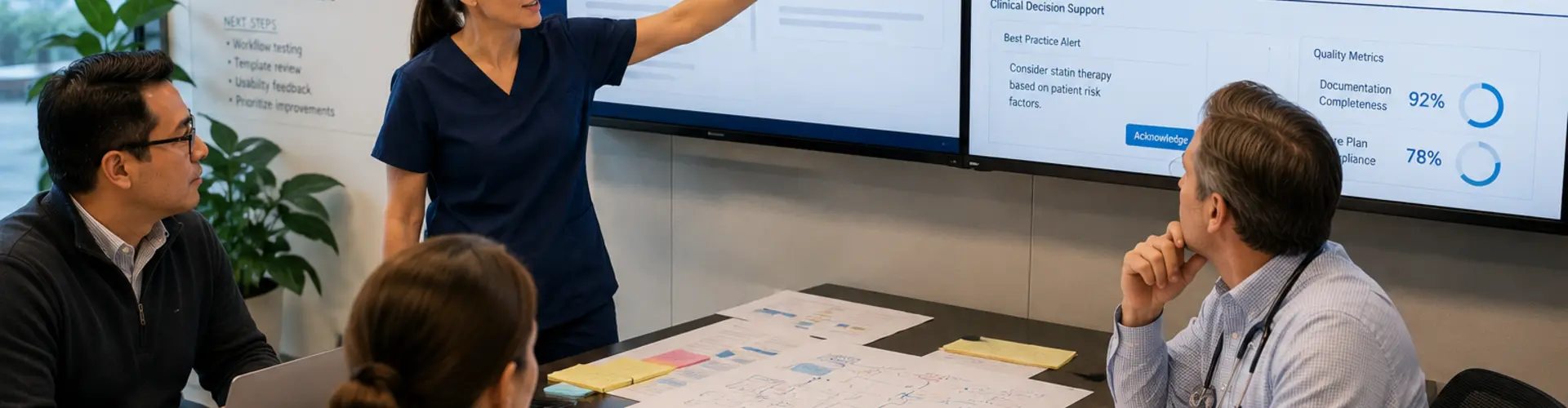
Your morning might begin with a meeting involving physicians, nurse practitioners, physician associates, nurses, pharmacists, IT analysts, and operational leaders who are preparing to launch a new documentation workflow. Rather than talking about software features, the discussion centers on patient care. Will the new workflow make documentation more efficient? Are important clinical details easier to find? Could the changes unintentionally create new challenges for frontline clinicians?
Later that morning, you might leave the conference room and spend time shadowing clinicians in a busy emergency department or outpatient clinic. Rather than assuming where problems exist, you watch how providers actually interact with the technology. Perhaps physicians are documenting the same information in multiple places, nurses are navigating unnecessary screens to administer medications, or clinicians are bypassing alerts because they appear so frequently that they've become background noise. Those observations often become the starting point for improvements that make the technology work the way clinicians naturally practice instead of forcing clinicians to adapt to inefficient software.
The afternoon may involve testing changes within the electronic health record, reviewing user feedback, participating in meetings about patient safety or quality improvement, or helping develop educational resources before a new system update goes live. Some days include training clinicians on new technology. Others focus on evaluating vendor solutions, supporting artificial intelligence initiatives, or collaborating with leadership on long-term digital health strategies.
The rhythm of the work is very different from clinical practice. Instead of moving quickly from one patient encounter to the next, you're focused on solving larger operational problems that affect clinicians across an entire organization. Success isn't measured by the number of patients you see during the day. It's measured by creating technology and workflows that help thousands of clinicians deliver safer, more efficient patient care.
The Skills You Already Have
One of the biggest misconceptions about transitioning into clinical informatics is that you need to become an information technology expert before anyone will consider hiring you.
In reality, many of the qualities that make someone an outstanding advanced practice professional are the same qualities organizations value in clinical informatics.
Clinical experience sits at the top of that list. Every day you've spent caring for patients has given you insight into how healthcare actually works. You understand documentation demands, communication challenges, clinical workflows, patient safety concerns, and the countless small decisions clinicians make throughout a busy day. That perspective is difficult to teach, which is why healthcare organizations actively seek clinicians who can help bridge the gap between technology and patient care.
Problem-solving is equally important. Experienced APPs routinely identify patterns, adapt when situations change unexpectedly, and make thoughtful decisions based on incomplete information. Clinical informatics professionals rely on those same skills as they evaluate workflows, identify opportunities for improvement, and help design solutions that work in real clinical environments.
Communication is another strength that transfers naturally. Informatics professionals spend much of their time bringing together people with different areas of expertise. One meeting may include physicians, nurses, software analysts, administrators, and project managers, all approaching the same problem from different perspectives. The ability to translate clinical needs into practical solutions—and explain technical changes in language clinicians understand—is one of the profession's most valuable skills.
While you'll certainly learn new technology, healthcare systems, and industry terminology, your clinical background provides the foundation employers value most. Technology can be taught. Years of frontline patient care experience cannot.
What You Don't Need to Know
One concern keeps many advanced practice professionals from seriously considering clinical informatics:
"I'm interested, but I'm just not technical enough."
It's an understandable assumption. After all, the word informatics sounds like a career built for software developers, data scientists, and information technology specialists—not clinicians who have spent years caring for patients.
In reality, that's one of the biggest misconceptions about the profession.
Healthcare organizations aren't looking for clinicians to replace their IT departments. They already employ software engineers, systems analysts, programmers, database administrators, cybersecurity specialists, and technical support teams. Those professionals understand how technology works.
What organizations often need is someone who understands how healthcare works.
They need clinicians who can recognize when documentation takes too long, identify workflows that create unnecessary frustration, explain why a particular alert is being ignored, or understand how a seemingly small software change could affect patient safety. They need people who can sit in a room with physicians, nurses, pharmacists, administrators, and technology specialists and help each group understand the others' perspective.
That's where experienced advanced practice professionals bring tremendous value.
Your years of caring for patients have taught you things that can't be learned from a programming course. You understand the realities of a busy clinic schedule, the importance of efficient documentation, the challenges of coordinating care across multiple disciplines, and the countless decisions clinicians make during every shift. Those experiences give context to technology in a way that purely technical expertise never can.
That doesn't mean you'll never learn new technical concepts. Like any career transition, clinical informatics comes with its own language, systems, and tools. Over time, you'll become familiar with topics such as clinical decision support, interoperability, workflow analysis, data reporting, and health information systems. The important difference is that you're learning how to apply technology to healthcare—not learning technology for its own sake.
If you've spent years thinking critically, solving problems, communicating effectively, and adapting to an ever-changing clinical environment, you've already developed many of the qualities that successful informatics professionals rely on every day.
The technology can be learned.
The perspective you've gained as a clinician cannot.
What Might Surprise You About Becoming a Clinical Informatics Professional
Many clinicians begin exploring clinical informatics because they enjoy technology or are looking for an alternative to traditional patient care. While those are certainly common reasons to investigate the field, they aren't what surprises most people after they make the transition.
One of the biggest adjustments is realizing that the work isn't really about technology—it's about people.
Another common surprise is how quickly the work changes. One month your team may be preparing for a major electronic health record upgrade. The next, you could be evaluating ambient AI documentation tools, exploring ways to reduce clinician burnout through workflow improvements, or helping implement remote patient monitoring technology. As healthcare continues adopting artificial intelligence, predictive analytics, digital health platforms, and new clinical technologies, informatics professionals are often among the first clinicians asked to evaluate how those innovations can be integrated safely into patient care. For people who enjoy learning and solving new problems, that constant evolution keeps the work intellectually engaging.
Many clinicians are also surprised by how collaborative the work becomes. Rarely are decisions made by one individual. Most projects involve multidisciplinary teams that include physicians, advanced practice professionals, nurses, pharmacists, quality leaders, operational managers, and information technology specialists. Reaching the best solution often requires balancing patient safety, regulatory requirements, clinician workflow, organizational goals, and technical limitations all at the same time.
Another common surprise is the pace of change. Healthcare technology continues to evolve rapidly as organizations invest in artificial intelligence, predictive analytics, telehealth, remote patient monitoring, digital health tools, and increasingly sophisticated electronic health records. For clinicians who enjoy continuous learning, that constant evolution can be one of the most rewarding aspects of the profession. Few projects are exactly alike, and every new initiative presents another opportunity to improve the way care is delivered.
Many informatics professionals also choose to maintain some level of clinical practice. Depending on the employer and the position, continuing to see patients on a limited basis allows clinicians to maintain their skills while staying closely connected to the real-world challenges facing frontline providers. That ongoing clinical perspective can become one of their greatest strengths when evaluating new technologies or recommending workflow improvements.
None of these realities are reasons to pursue—or avoid—the profession. They simply highlight that clinical informatics is much more than working with computers. At its core, it's a career built around improving healthcare by combining clinical experience with thoughtful problem-solving and collaboration.
How Competitive Is the Field?
Clinical informatics has become one of the fastest-growing areas within healthcare, but that doesn't necessarily mean every position is easy to obtain. As more health systems invest in digital transformation, electronic health record optimization, artificial intelligence, and data-driven decision making, the demand for clinicians who understand both patient care and technology continues to grow. At the same time, many of these positions attract experienced healthcare professionals looking to expand their careers beyond traditional clinical practice.
That competition doesn't mean the field is difficult to enter. It simply means employers are looking for more than clinical experience alone.
Strong candidates typically demonstrate curiosity, adaptability, and a genuine interest in improving healthcare systems. Employers value clinicians who have participated in EHR optimization projects, quality improvement initiatives, workflow redesign, clinical committees, or technology implementations within their organizations. Experience doesn't always need to come from a formal informatics title. In many cases, involvement in projects outside of everyday patient care provides valuable experience that demonstrates both interest and initiative.
Professional development can also strengthen your qualifications. Some clinicians pursue certificates or graduate coursework in clinical informatics, healthcare informatics, or health information management, while others build experience through internal committees, vendor training, or leadership opportunities. Depending on your long-term goals, formal education may be helpful, but practical experience improving clinical workflows is often just as valuable.
Like many non-clinical career transitions, entering clinical informatics usually requires patience. Some clinicians move into dedicated informatics positions after serving as "super users" or project champions within their organizations. Others gradually build experience over several years before making the transition full-time. The path isn't always direct, but for clinicians who genuinely enjoy the work, the investment can be well worth it.
Who Thrives in Clinical Informatics?
By this point, you've probably realized that clinical informatics isn't simply a technology career with a clinical background. Success depends just as much on curiosity, communication, and problem-solving as it does on healthcare experience.
The clinicians who thrive in informatics are often the ones who naturally ask questions. Instead of accepting that a workflow is inefficient because "that's how we've always done it," they're interested in understanding why the process exists and whether it can be improved. They enjoy solving problems, identifying patterns, and finding practical ways to make healthcare work better for both clinicians and patients.
Successful informatics professionals are also lifelong learners. Technology evolves quickly, and healthcare organizations continue adopting new digital tools that change the way care is delivered. If you enjoy learning new systems, exploring emerging technologies, and staying current with innovations shaping healthcare, you'll likely find the work intellectually stimulating.
Collaboration is another defining characteristic. Informatics professionals rarely work in isolation. They spend much of their time bringing together people with different backgrounds and perspectives, helping clinicians, administrators, and technology specialists work toward common goals. Listening carefully, communicating clearly, and building consensus are just as important as understanding the technology itself.
Perhaps most importantly, clinicians who thrive in informatics enjoy thinking beyond individual patient encounters. They find satisfaction in improving systems that make care safer, more efficient, and less frustrating for thousands of patients and providers. While the impact may be less visible than caring for patients face-to-face, it can be every bit as meaningful.
Who May Not Enjoy This Role?
Every career has trade-offs, and clinical informatics is no exception. One of the best ways to evaluate this path is to think honestly about the parts of your current job that bring you the greatest sense of fulfillment.
If the highlight of your day is direct patient interaction, you may find it difficult to replace that experience. Although clinical informatics professionals improve patient care in meaningful ways, they do so indirectly. Their success is measured by stronger systems, safer workflows, and better technology rather than the relationships they build with individual patients.
This career may also feel less satisfying for clinicians who enjoy the fast pace and immediate decision-making of a busy clinical practice. Informatics projects often unfold over weeks or months, requiring collaboration, planning, testing, and refinement before changes are implemented. Progress is steady, but it's rarely immediate.
The work also involves frequent meetings, project planning, and cross-functional collaboration. Clinicians who prefer highly independent work or who have little interest in technology may find those aspects less rewarding than direct patient care.
None of these characteristics make clinical informatics better or worse than traditional practice. They simply make it different. The goal isn't to decide whether informatics is an excellent career—it clearly is for many clinicians. The goal is determining whether it's the right career for you.
How to Prepare for a Career in Clinical Informatics
If this career feels like a natural fit, resist the temptation to immediately begin submitting applications. The clinicians who make the smoothest transition into clinical informatics usually spend time building relevant experience before they ever interview for a dedicated role.
One of the best places to start is within your current organization. Many hospitals and healthcare systems regularly seek clinicians to participate in EHR optimization projects, workflow redesign initiatives, clinical technology committees, and software implementations. Volunteering for these opportunities not only exposes you to the field but also demonstrates your interest in improving healthcare systems beyond direct patient care.
Take time to become familiar with the language of informatics as well. While you don't need to become a software engineer, understanding concepts such as clinical decision support, interoperability, data governance, workflow optimization, user experience, and health information exchange will help you better understand the profession and communicate more confidently during interviews.
Professional development can also strengthen your qualifications. Some clinicians pursue graduate certificates or master's degrees in health or clinical informatics, while others complete continuing education courses offered by universities and professional organizations. Depending on the position you're pursuing, formal education may be beneficial, but it's rarely a substitute for real-world experience improving clinical workflows.
Networking is equally important. Connect with clinicians already working in informatics, attend healthcare technology conferences, participate in webinars, and consider joining organizations such as the Healthcare Information and Management Systems Society (HIMSS) or the American Medical Informatics Association (AMIA). Conversations with professionals already working in the field often provide practical insights that can't be found in a job description.
Finally, take a fresh look at your resume. Rather than focusing exclusively on patient volumes, procedures, or clinical responsibilities, highlight experiences that demonstrate leadership, collaboration, quality improvement, workflow redesign, committee participation, technology implementation, education, or project management. Those experiences often tell a stronger story about your readiness for informatics than clinical responsibilities alone.
Preparing for a career in clinical informatics isn't about checking a series of boxes. It's about demonstrating that you're ready to improve healthcare from a systems perspective while building on the clinical expertise you've already earned.
Is a Career in Clinical Informatics Right for You?
Few career transitions ask clinicians to think differently about healthcare quite like clinical informatics.
The move isn't simply a change in job title. It's a shift in how you create impact.
For some advanced practice professionals, the opportunity to improve systems, influence patient care across an entire organization, and help shape the future of healthcare technology is exactly the challenge they've been looking for. They enjoy solving complex problems, collaborating with multidisciplinary teams, and knowing that improvements they help create may benefit thousands of patients and clinicians for years to come.
Others may realize that the aspects of healthcare they value most happen during direct patient care. The relationships they build, the clinical decision-making they experience throughout the day, and the immediate satisfaction of helping patients remain the most rewarding parts of their profession.
Neither conclusion is better than the other.
The purpose of exploring careers like clinical informatics isn't to convince yourself to leave clinical practice. It's to better understand the opportunities available as your career evolves. The more informed your decision, the more likely you are to build a career that remains professionally challenging, personally fulfilling, and aligned with your strengths.
Whether you ultimately pursue a position in clinical informatics or decide your future belongs elsewhere, taking the time to explore careers beyond traditional practice is never wasted. Every conversation, every new skill, and every opportunity to broaden your perspective helps you make better decisions about the next chapter of your professional life.
Clinical Informatics at a Glance
| Category | Overview |
|---|---|
| Primary Focus | Improving healthcare technology, clinical workflows, and digital systems that support patient care |
| Direct Patient Care | Varies by position; some clinicians maintain part-time practice while others transition to fully non-clinical roles |
| Typical Employers | Hospitals, health systems, academic medical centers, healthcare technology companies, consulting firms, EHR vendors, insurers, and government organizations |
| Work Environment | Office, hybrid, or remote depending on the employer; highly collaborative and project-based |
| Travel | Usually low, although consulting and vendor positions may require occasional travel |
| Typical Schedule | Primarily weekday business hours with project-based deadlines |
| Compensation | Competitive and often comparable to or higher than many traditional APP positions, depending on experience and employer |
| Transition Difficulty | Moderate; prior involvement with technology, quality improvement, or workflow projects is often helpful |
| Best Fit For | APPs who enjoy technology, problem-solving, collaboration, workflow improvement, and systems thinking |
| May Not Be Ideal For | Clinicians who thrive on continuous direct patient care, fast-paced clinical environments, or procedural practice |
Looking for Clinical Informatics Opportunities?
While many clinical informatics positions are found within hospitals and health systems, opportunities are also available with healthcare technology companies, consulting firms, insurers, government agencies, and electronic health record vendors.
If you're interested in exploring where your clinical experience can take you next, browse current Clinical Informatics and related healthcare leadership, quality improvement, and healthcare technology opportunities on HealthJobsNationwide.com.