Nov 25, 2025 ● APJ Staff Writer
More NPs, PAs, and CRNAs Are Choosing Flexible Work Models Find Out Why
If you're an advanced practice provider, you've probably felt it.
Maybe it's the charting that follows you home after clinic. Maybe it's the extra shift that seemed manageable until it became routine. Or maybe it's the realization that even on your days off, you're still mentally carrying the weight of patient care, inbox messages, and everything waiting for you when you return.
Across healthcare, more nurse practitioners, physician assistants, and CRNAs are asking the same question:
Is this pace sustainable long term?
For many clinicians, the answer is becoming increasingly complicated.
Healthcare organizations continue to face staffing shortages, growing patient demand, and increasing pressure to improve access to care. At the same time, APPs are rethinking what they want from their careers. Compensation remains important, but so do flexibility, autonomy, work-life balance, and long-term professional fulfillment.
As a result, flexible work models are no longer viewed as alternative career paths. They're becoming a core part of how advanced practice providers build sustainable careers.
The Traditional Full-Time Model Is No Longer the Only Option
For decades, the standard healthcare career path followed a familiar structure: full-time employment, fixed schedules, long-term commitment to a single organization, and limited flexibility.
That model still works well for many clinicians. However, it is no longer the only path available.
Healthcare organizations are increasingly incorporating a mix of full-time, part-time, per diem, locum tenens, telehealth, hybrid, and fractional positions to meet changing workforce needs. Rather than relying exclusively on traditional staffing structures, employers are creating more adaptable workforce models that allow them to respond to fluctuating patient demand while offering clinicians greater schedule flexibility.
For APPs, this means more career choices than ever before.
Instead of asking, "Which job should I take?" many clinicians are now asking, "What type of career structure works best for my life?"
Why More APPs Are Looking for Flexibility
Several trends are driving the shift toward flexible work arrangements.
Burnout remains one of the biggest factors. While healthcare has always been demanding, many clinicians report feeling increasingly stretched by administrative responsibilities, staffing shortages, documentation requirements, and growing patient complexity.
For nurse practitioners and physician assistants, the workday often extends beyond patient visits. Managing inbox messages, reviewing laboratory results, responding to refill requests, coordinating referrals, and completing documentation can consume hours outside scheduled clinic time.
CRNAs face their own challenges, including call responsibilities, long surgical days, staffing shortages, and the physical demands of procedural care.
At the same time, many clinicians are reassessing what career success means to them. Earlier generations often viewed long hours and constant availability as part of professional commitment. Today's workforce is more likely to prioritize sustainability, family time, personal well-being, and schedule control alongside career advancement.
This shift is not about clinicians caring less about their work. In many cases, it reflects a growing desire to remain engaged in healthcare without sacrificing long-term health and quality of life.
What Flexible Work Actually Looks Like for APPs
Flexible work can take many forms depending on specialty, experience level, and career goals.
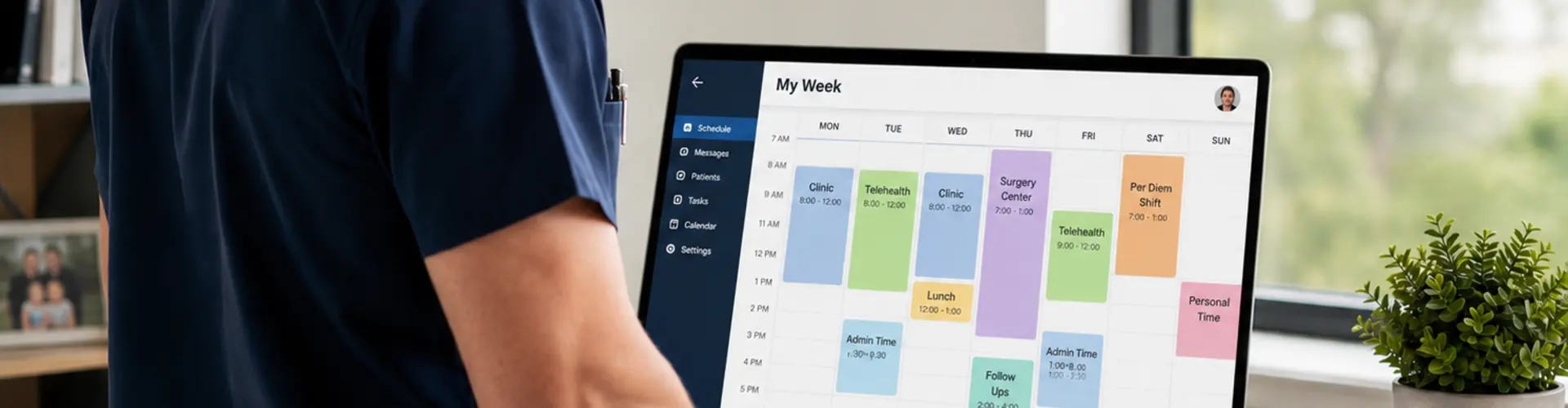
A family nurse practitioner might work three clinic days per week while providing telehealth visits on another day. A physician assistant may split time between surgical first assist work and outpatient specialty care. A CRNA could combine hospital coverage with ambulatory surgery center shifts to gain greater schedule control.
Common flexible work models include:
- Part-time clinical positions
- Per diem opportunities
- Locum tenens assignments
- Telehealth roles
- Hybrid in-person and virtual schedules
- Internal float pool positions
- Fractional employment arrangements
- Multi-site coverage models
These arrangements allow clinicians to customize their careers in ways that were far less common just a decade ago.
The Rise of Fractional APP Careers
One of the most interesting developments in healthcare staffing is the growth of fractional roles.
Fractional employment allows clinicians to work a defined percentage of a traditional full-time schedule, often between 20% and 80% FTE, while maintaining a consistent relationship with an organization.
For healthcare systems, fractional roles create workforce flexibility. For APPs, they provide income stability while leaving room for additional professional interests.
Some clinicians use that time for teaching, consulting, telehealth work, leadership development, or family responsibilities. Others simply value having more control over how their professional and personal lives fit together.
As organizations continue competing for experienced clinicians, fractional employment is becoming an increasingly attractive recruitment and retention strategy.
Flexible Work and Career Sustainability
One reason flexible work continues to gain momentum is its connection to long-term career sustainability.
Many APPs don't necessarily want to leave healthcare. They want to practice in a way that feels sustainable for the next ten, twenty, or thirty years.
Research consistently shows that greater schedule control is associated with lower burnout, higher job satisfaction, and improved clinician well-being. When providers have more influence over how and when they work, they often report feeling more engaged and more likely to remain in clinical practice.
This is particularly important as healthcare faces ongoing workforce shortages. Retaining experienced clinicians may be just as important as recruiting new ones.
Flexible work models help organizations accomplish both goals.
How Flexible Staffing Benefits Patients
Flexible work arrangements are often discussed through the lens of clinician wellness, but patient care benefits as well.
Clinicians who feel supported and less overwhelmed are generally better positioned to provide attentive, patient-centered care. They may have greater emotional availability, improved focus, and more capacity to engage meaningfully with patients.
Healthcare organizations that successfully implement flexible staffing strategies often report improvements in retention, patient satisfaction, and operational efficiency.
Healthy clinicians contribute to healthier healthcare systems.
Understanding the Trade-Offs
Flexible work offers significant advantages, but it is not the right fit for everyone.
Many flexible positions do not include the same benefits packages available through traditional full-time employment. Health insurance, retirement contributions, paid time off, and disability coverage may be reduced or unavailable depending on the arrangement.
Income can also be less predictable. Some clinicians thrive with that flexibility, while others prefer the stability of a guaranteed salary.
There may also be differences in workplace connection. Per diem, locum, and fractional clinicians sometimes report feeling less integrated into organizational culture or less involved in long-term team development.
For clinicians considering flexible work, understanding both the advantages and limitations is essential.
The goal is not to find a perfect model. The goal is to find a model that aligns with your priorities.
Technology Is Accelerating the Shift
Technology continues to play a major role in expanding flexible career opportunities.
Telehealth platforms have created entirely new ways for APPs to deliver care. Staffing technology now allows organizations to match clinicians with open shifts more efficiently. Artificial intelligence and automation tools are helping reduce administrative burden and improve workforce planning.
These innovations are not replacing clinicians. Instead, they are creating more options for how clinicians choose to work.
As healthcare technology continues to evolve, career flexibility is likely to increase alongside it.
What This Means for Today's APP Job Market
For clinicians actively exploring new opportunities, the APP job market looks very different than it did even a few years ago.
Many organizations now offer flexible scheduling options as part of their recruitment strategy. Telehealth opportunities continue to expand. Locum tenens assignments remain strong across multiple specialties. Hybrid roles are becoming increasingly common.
When evaluating opportunities, clinicians may benefit from looking beyond salary alone and asking questions such as:
- How much schedule flexibility exists?
- What does work-life balance actually look like?
- How is call distributed?
- What support systems are available?
- Are there opportunities for hybrid or remote work?
- How does the organization approach clinician well-being?
These questions often reveal more about long-term job satisfaction than compensation alone.
Frequently Asked Questions About Flexible APP Careers
Are flexible APP jobs becoming more common?
Yes. Healthcare organizations increasingly use part-time, per diem, telehealth, locum tenens, and hybrid positions to address staffing shortages and improve retention.
Do flexible APP jobs pay less?
Not necessarily. Many flexible positions offer competitive or even higher hourly compensation. However, benefits may differ from traditional full-time employment.
What specialties offer the most flexibility?
Primary care, urgent care, psychiatry, hospital medicine, telemedicine, anesthesia, and certain specialty practices often provide flexible scheduling options.
Can new graduate NPs and PAs find flexible positions?
Some can, although employers often prefer experienced clinicians for highly autonomous or locum-based roles. New graduates may have more options after gaining initial clinical experience.
Are flexible work arrangements better for preventing burnout?
Flexible schedules alone do not eliminate burnout, but greater control over workload and scheduling has been consistently associated with improved job satisfaction and lower rates of clinician stress.
The Bottom Line
The traditional full-time APP role is not disappearing, but it is no longer the only path available.
As healthcare organizations adapt to workforce shortages and clinicians prioritize sustainability, flexible work models are becoming a permanent part of the advanced practice landscape. Part-time schedules, telehealth opportunities, locum assignments, hybrid positions, and fractional roles are giving APPs more control over how they build their careers.
For many nurse practitioners, physician assistants, and CRNAs, the appeal isn't simply flexibility.
It's the opportunity to create a career that supports professional growth, personal well-being, and long-term fulfillment at the same time.
And for a growing number of clinicians, that may be exactly what modern healthcare has been missing.
Disclaimer: The viewpoint expressed in this article is the opinion of the author and is not necessarily the viewpoint of the owners or employees at Healthcare Staffing Innovations, LLC.